Monday, 11 March 2024

TEMPLE ARCHITECTURE AND SCULPTURE (PART:-2)

TEMPLE ARCHITECTURE AND SCULPTURE

 (2) The Dravida Or South Indian Temple Style

  • Unlike the nagara temple, the Dravida temple is enclosed within a compound wall.
  • The front wall has an entrance gateway in its centre, which is known as a gopuram.
  • The shape of the main temple tower known as vimana 
  • In Tamil Nadu is like a stepped pyramid that rises up geometrically rather than the curving shikhara of North India.
  •  In the South Indian temple, the word ‘shikhara’ is used only for the crowning element at the top of the temple which is usually shaped like a small stupika or an octagonal cupola— this is equivalent to the amlak and kalasha of North Indian temples.
  •  The entrance to the North Indian temple’s garbhagriha, it would be usual to find images such as mithunas and the river goddesses, Ganga and Yamuna, in the south you will generally find sculptures of fierce dvarapalas or the door-keepers guarding the temple.
  • It is common to find a large water reservoir, or a temple tank, enclosed within the complex.
  •  The North Indian idea of multiple shikharas rising together as a cluster was not popular in South India.
  •  Some of the most sacred temples in South India, the main temple in which the garbhagriha is situated has, in fact, one of the smallest towers. This is because it is usually the oldest part of the temple.
  • Example in the Sriranganathar Temple at Srirangam, Tiruchirappally, there are 7 concentric rectangular enclosure walls each having gopurams. The tower at the centre has the garbhagriha.

  • Famous temple towns of Tamil Nadu: Kanchipuram, Thanjavur (Tanjore), Madurai and Kumbakonam.
  • In the 8th to 12th centuries – temples were not confined to being religious centres but became administrative centres as well with large swathes of land.
 Subdivisions  of Dravida temples:

  1. Kuta or Caturasra: square-shaped
  2. Shala or Ayatasra: rectangular-shaped
  3. Gaja-prishta or vrittayata or elephant-backed: elliptical
  4. Vritta: circular
  5. Ashtasra: octagonal

Pallava Architecture

  • The Pallavas were one of the ancient South Indian dynasties that were active in the Andhra region from the second century CE onwards and moved south to settle in Tamil Nadu.
  • They built many monuments and temples during the 6th to the 8th centuries.
  • Although they were mostly Shaivite, some Vaishnava monuments are also seen. Their architecture was also influenced by the Buddhist heritage of the Deccan.
  • Their early buildings were rock-cut whereas the later were structural.
  • The early buildings were built during the reign of Mahendravarman I, a contemporary of the Chalukya king Pulakeshin II of Karnataka.
  • His son Narasimhavarman I, also known as Mamalla, was a great patron of the arts. Most buildings in Mahabalipuram (also called Mamallapuram in his honour) are attributed to him.
  • In Mahabalipuram, there are exquisite monolithic rathas and mandapas. The five rathas are known as Panchapandava Rathas.

Dravidian Temple Architecture – 

1 Shore Temple – Mahabalipuram


  • The shore temple at Mahabalipuram was built later, probably in the reign of Narasimhavarman II
  • known as Rajasimha who reigned from 700 to 728 CE.
  • It has three shrines – one Shiva shrine facing east, one Shiva shrine facing west, a middle shrine to Vishnu in Anantashayana pose. The presence of three main shrines is unique.
  • It is probable that the shrines were not all built at the same time but were added later.
  • There is evidence of a water reservoir and a gopuram.
  • There are sculptures of Nandi the bull (Shiva’s mount) along the walls of the temple. There are several carvings as well.

2 Brihadiswara Temple – Tanjore


  • Shiva temple, also called Rajarajeswara Temple.
  • Completed around 1009 AD. Built by Rajaraja Chola.
  • It is the largest and tallest of all Indian temples. This Chola temple is bigger than any of the previous Pallava, Chalukya or Pandya structures.
  • More than 100 temples of the Chola Period are preserved. A lot of temples were constructed during the Chola period.
  • Its pyramidal multi-storied vimana is almost 70 metres high.
  • There is a monolithic shikhara atop the vimana.
  • The shikhara is a dome-shaped octagonal stupika. It has two large elaborately sculptured gopuras. On the shikhara, there are large Nandi images.
  • The kalasha on top of the shikhara is 3m and 8cm tall.
  • There are hundreds of stucco figures on the vimana. Many might have been added later on in the Maratha period.
  • The main deity of Shiva is portrayed as a huge lingam set in a double-storied sanctum.
  • The surrounding walls of the sanctum are adorned with painted murals and sculptures of mythological stories.

Architecture in the Deccan

  • A hybridised style mixing elements from both Nagara and Dravida styles emerge as a distinct style during the middle of the 7th century in regions like Karnataka.
  • This is referred to as Vesara in some ancient texts.
  • Some of the temples are either completely nagara or dravida. Not all temples in the Deccan are in vesara style.
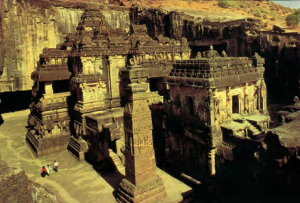
  • Kailashnath Temple, Ellora
  • Completely in Dravida style.
    • Main deity is Lord Shiva.
    • There is also a Nandi shrine.
    • Vimana rises 30 m.
    • This temple was carved out of a portion of a hill.
    • The temple is grand and imposing.
    • Built during the Rashtrakuta phase at Ellora.

Chalukya Architecture

  • Western Chalukya kingdom was established by Pulakesin I when he took control of the land around Badami in 543 AD.
  • Early western Chalukyas ruled the region till around the mid-8th century.
  • Early activities are rock-cut caves while structural temples were built later on.
  • Ravana Phadi cave at Aihole
    • Important structure at this site: Nataraja
    • This image is surrounded on the right by four large saptamatrikas and on the left by three large ones.
    • The figures have slim, graceful bodies. They have long oval faces. They wear short pleated dhotis and tall cylindrical crowns.
  • Distinct feature of Chalukya architecture: mixing and incorporation of several styles.
  • Temples at Pattadakkal, Karnataka
    • Pattadakkal is a UNESCO World Heritage Site.
    • There are 10 temples. Four are in Dravida style, four are in Nagara style, one (Papanatha Temple) is a fusion of both and one is a Jain temple.
    • Jain Narayana temple – built by Rashtrakutas in the 9th century.
    • Virupaksha Temple – built by the chief queen of Chalukya king Vikramaditya II (733 – 44), Loka Mahadevi. Best example of Dravida style.
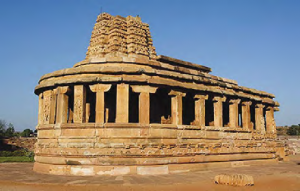
  • Durga Temple, Aihole
  • Apsidal shrine resembling a Buddhist Chaitya hall.
    • Surrounded by a veranda.
    • Shikhara is like a nagara one.
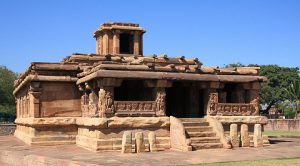
  • The Lad Khan temple at Aihole
  • Located south of the Durga temple. Built in the 5th century.
    • Inspired by the wooden-roofed temples of the hills, but is made out of stone.
    • Built in the Panchayatana style.
    • So named because a person named Lad Khan had used it as his residence for some time.

Hoysalas Temple Architecture

  • Hoysalas grew into prominence in South India after the Chola and the Pandya power declined.
  • Centred at Mysore.
  • Chief temples are at Belur, Somnathapuram and Halebidu.
  • These temples have a plan called the stellate plan. This is because the plan which emerged from being a straightforward square to a complex one with many projecting angles began to resemble a star.
  • The star-like ground plan is a distinct feature of Hoysala architecture.
  • Style is Vesara.
  • Made of soapstone which is relatively soft. This enabled artists to carve intricate details like jewellery.
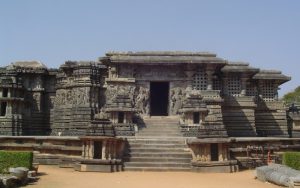
  • Hoysaleshvara Temple, Halebid
  • Made of dark schist stone in 1150.
    • Dedicated to Nataraja (Shiva).
    • It is a double building with a large hall for the mandapa.
    • A Nandi pavilion is in front of each building.
    • The temple’s tower fell a long time back. The structure of the temple is evident from the detailed miniature ones at the temple’s entrance.
    • Very intricate and detailed carvings.

Vijayanagara Architecture

  • City of Vijayanagara (City of victory) founded in 1336.
  • Visited by international travellers like Niccolo di Conti, Domingo Paes, Duarte Barbosa, Abd, al-Razzaq, etc. who have given vivid accounts of the place.
  • Synthesizes the Dravida style with Islamic styles of the neighbouring sultanates.
  • The sculpture tries to recreate the Chola tradition but the foreign influence is also seen.

Sunday, 10 March 2024

TEMPLE ARCHITECTURE AND SCULPTURE (PART:-1)

TEMPLE ARCHITECTURE  AND SCULPTURE


Introduction

MOST of the art and architectural remains that survive from Ancient and Medieval India are religious in nature. That does not mean that people did not have art in their homes at those times, but domestic dwellings and the things in them were mostly made from materials like wood and clay which have perished. This chapter introduces us to many types of temples from India. Although we have focused mostly on Hindu temples, at the end of the chapter you will find some information on major Buddhist and Jain temples too. However, at all times, we must keep in mind that religious shrines were also made for many local cults in villages and forest areas, but again, not being of stone the ancient or medieval shrines in those areas have also vanished.

Early Temples

  •  While construction of stupas continued, Brahmanical temples and images of gods also started getting constructed.
  • Often temples were decorated with the images of gods.
  •  Myths mentioned in the Puranas became part of narrative representation of the Brahmanical religion. 
  • Each temple had a principal image of a god.
  •  The shrines of the temples were of three kinds—(i) sandhara type (without pradikshinapatha), (ii) nirandhara type (with pradakshinapatha), and (iii) sarvatobhadra (which can be accessed from all sides).
  •  Some of the important temple sites of this period are Deogarh in Uttar  Pradesh, Eran, Nachna-Kuthara and Udaygiri near Vidisha in Madhya Pradesh.
  • These temples are simple structures consisting of a veranda, a hall and a shrine at the rear.
The Form Of The Hindu Temple
 The basic form of the Hindu temple comprises the following:
  1. Sanctum (garbhagriha literally ‘womb-house’), which was a small cubicle with a single entrance and grew into a larger chamber in time. The garbhagriha is made to house the main icon which is itself the focus of much ritual attention.
  2. The entrance to the temple which may be a portico or colonnaded hall that incorporates space for a large number of worshippers and is known as a mandapa.
  3. Freestanding temples tend to have a mountain-like spire, which can take the shape of a curving shikhar in North India and a pyramidal tower, called a vimana, in South India.
  4. the vahan, i.e., the mount or vehicle of the temple’s main deity along with a standard pillar or dhvaj is placed axially before the sanctum.
Types Of Indian Temple Architecture/ Styles

Basically there are 3 kinds of temple architecture:

  1. Nagara Style :- Nagara in the north
  2. Dravida Style :- Dravida in the south
  3. Vesara Style :- The Vesar style of temples as an independent style created through the selective mixing of the Nagara and Dravida orders is mentioned by some scholars.
 Sculpture, Iconography and Ornamentation
  • The study of images of deities falls within a branch of art history called ‘iconography’, which consists of identification of images based on certain symbols and mythologies associated with them.
  •  Every region and period produced its own distinct style of images with its regional variations in iconography.
  •  The temple is covered with elaborate sculpture and ornament that form a fundamental part of its conception.
  • The placement of an image in a temple is carefully planned:  for instance, river goddesses (Ganga and Yamuna) are usually found at the entrance of a garbhagriha in a Nagara temple, dvarapalas (doorkeepers) are usually found on the gateways or gopurams of Dravida temples, similarly, mithunas (erotic images), navagrahas (the nine auspicious planets) and yakshas are also placed at entrances to guard them.
  • The deities of directions, i.e., the ashtadikpalas face the eight key directions on the outer walls of the sanctum and/or on the outer walls of a temple.
  • Subsidiary shrines around the main temple are dedicated to the family or incarnations of the main deity. Finally, various elements of ornamentation such as gavaksha, vyala/yali, kalpa-lata, amalaka, kalasha, etc. are used in distinct ways and places in a temple.
(1) The Nagara or North Indian Temple Style


  • The style of temple architecture that became popular in northern India is known as nagara.
  • In North India it is common for an entire temple to be built on a stone platform with steps leading up to it.
  • unlike in South India it does not usually have elaborate boundary walls or gateways. While the earliest temples had just one tower, or shikhara, later temples had several.
  • The garbhagriha is always located directly under the tallest tower.
Subdivisions of Nagara Style

Friday, 8 March 2024

LATER MURAL TRADITIONS

 LATER MURAL TRADITIONS

EVEN after Ajanta, very few sites with paintings have survived which provide valuable evidences to reconstruct the tradition of paintings. It may also be noted that the sculptures too were plastered and painted. The tradition of cave excavations continued further at many places where sculpting and painting were done simultaneously.

Badami

  • One such site is Badami in the State of Karnataka.
  •  Badami was the capital of the early Chalukyan dynasty which ruled the region from 543 to 598 CE.
  • Badami was the capital of the western Chalukyan dynasty.
  • The Chalukya king, Mangalesha, patronised the excavation of the Badami caves. He was the younger son of the Chalukya king.
  • Mangalesha was the younger son of Pulakesi I and the brother of Kirtivarman I.
  • Cave No. 4 is also known as the Vishnu Cave because of the dedication of the image of Vishnu. The date 578 – 579 CE is mentioned here. Thus, we get the period during which the cave was carved and also the Vaishnava leanings of the patron.
  • Paintings depict palace scenes. A painting shows Kirtivarman seated in the palace and watching a dance scene with his wife and feudatories.
  • The paintings are an extension of the mural painting tradition from Ajanta to Badami in south India.
  • The faces of the king and queen are reminiscent of the modelling seen in Ajanta, with their eye-sockets large, eyes half-closed and protruding lips.
  • These artists of the 6th century CE were able to create volume by contouring different parts of the face to create protruding structures of the face itself.
Murals under the Pallava, Pandava and Chola Kings

  • The Pallava succeeded the Chalukyas further south in Tamil Nadu.
  • They were great patrons of the arts.
  • Mahendravarma I (7th century) built many temples in Panamalai, Mandagapattu and Kanchipuram.
  • An inscription at Mandagapattu mentions the king Mahendravarman I with several titles such as Vichitrachitta (curious-minded), Chaityakari (temple-builder) and Chitrakar Puli (tiger among artists) – showing his interest in artistic activities.
  • Paintings at the temple at Kanchipuram were patronised by the Pallava king Rajasimha.
  • Painting of Somaskanda here – only traces remain – large, round face.
  • There is increased ornamentation in this period as compared to the previous. But, the depiction of the torso is much the same although a bit elongated.
  • Pandya's also patronised art.
    • Examples: Thirumalapuram caves and Jaina caves at Sittanavasal.
    • Paintings are seen on the ceilings of the shrine, in verandas and on the brackets.
    • Dancing figures of celestial nymphs are seen.
    • Contours are in vermillion red and the bodies are painted yellow. Dancers have expressions on their faces and show supple limbs. Their eyes are elongated and sometimes protrude off the face. This is a distinctive feature seen in many later paintings in the Deccan and South India.
    • The Cholas ruled over the region from 9th to the 13th century CE.
      • The Cholas were at the height of their power in the 11th century CE and this is when their masterpieces appear.
      • Temples built during the reign of Rajaraja Chola and his son Rajendra Chola – Brihadeswara Temple at Thanjavur, at Gangaikonda Cholapuram, at Darasuram.
      • Chola paintings are seen in Narthamalai. Most important paintings are seen in the Brihadeswara Temple.
      • Two layers of paint were seen. The upper layer was executed during the Nayaka period (16th century). The Chola paintings (original layer) depict narrations and various forms of Lord Shiva, Shiva in Kailash, Shiva as Nataraja, as Tripura taka. Also there is a portrait of Rajaraja, his mentor Kuruvar, etc.
The tradition of building temples and embellishing them with carvings and paintings continued during the reign of the Chola kings who ruled over the region from the ninth to the thirteenth century. But it was in the eleventh century, when the Cholas reached their zenith of power, that masterpieces of the Chola art and architecture began to appear. The temples of Brihadeswara at Thanjavur, Gangaikonda Cholapuram and Darasuram in Tamil Nadu were built during the reigns of Rajaraja Chola, his son, Rajendra Chola and Raj a raja Chola II, respectively. Though Chola paintings are seen in Nartamalai, the most important are those in Brihadeswara temple. The paintings were executed on the walls of the narrow passage surrounding the shrine. Two layers of paintings were found when they were discovered. The upper layer was painted during the Nayak period, in the sixteenth century. Thanks to the cleaning of the surface painting, examples of the great tradition of painting during the Chola period were unveiled. The paintings show narrations and aspects related to Lord Shiva, Shiva in Kailash, Shiva as Tripurantaka, Shiva as Nataraja, a portrait of the patron Rajaraja and his mentor Kuruvar, dancing figures, etc.

 Vijayanagara Murals

  • After the Chola decline, the Vijayanagara dynasty brought the region from Hampi to Trichy under its control.
  • Hampi was the capital.
  • Paintings at Thiruparankundram, near Trichy (14th century), represent the early phase of the Vijayanagara style.
  • Virupaksha Temple at Hampi
    • Paintings on the ceilings of the Mandapa.
    • Depicting events from dynastic history and also from the Mahabharata and the Ramayana.
    • Examples of paintings: portraying Vidyaranya, Bukkaraya Harsha’s spiritual teacher carried in a palanquin in a procession; incarnations of Vishnu.
    • Faces and figures are shown in profile. Large frontal eyes, narrow waists.
  • Lepakshi in Andhra Pradesh – paintings on the walls of the Shiva Temple.
  • Features of Vijayanagara paintings:
    • Lines are still but fluid.
    • Faces are in profile.
    • Figures and objects are shown two-dimensionally.
    • These features were adopted by later artists such as those of the Nayaka Period.


      Paintings of the Nayaka dynasty in the seventeenth and eighteenth centuries are seen in Thiruparakunram, Sreerangam and Tiruvarur in Tamil Nadu. In Thiruparakunram, paintings are found of two different periods—of the fourteenth and the seventeenth century. Early paintings depict scenes from the life of Vardhaman Mahavira. 
The Nayaka paintings depict episodes from the Mahabharata and the Ramayana and also scenes from Krishna-leela. In Tiruvarur, there is a panel narrating the story of Muchukunda. In Chidambaram, there are panels of paintings narrating stories related to Shiva and Vishnu— Shiva as Bhikshatana Murti, Vishnu as Mohini, etc. In the Sri Krishna temple at Chengam in Arcot District there are 60 panels narrating the story of the Ramayana which represent the late phase of Nayaka paintings.

KERALA MURALS (during the period from the sixteenth to the eighteenth century)
The distinct style was developed but a lot of the features of the Nayaka and Vijayanagara styles were adopted.
  • The artists took ideas from the contemporary traditions of Kathakali and Kalam Ezhuthu.
  • Vibrant and luminous colours, human figures have shown 3-dimensionally.
  • Paintings on the walls of the shrines, on cloister walls of temples, also in palaces.
  • The theme of the paintings – from locally popular episodes of Hindu mythology, local versions of the Mahabharata and Ramayana through oral traditions.
  • More than 60 sites with mural paintings
    • Three palaces: Dutch Palace (Kochi), Krishnapuram palace (Kayamkulam), Padmanabhapuram palace (Travancore, now in Kanyakumari, Tamil Nadu).
    • Pundareekapuram Krishna temple
    • Panayannarkavu (temple), Thirukodithanam
    • Sri Rama temple, Triprayar
    • Vadakkunnathan temple, Thrissur
More than sixty sites have been found with mural paintings which include three palaces—Dutch palace in Kochi, Krishnapuram palace in Kayamkulam and Padmanabhapuram palace. Among the sites where one can see the mature phase of Kerala’s mural painting tradition are Pundareekapuram Krishna temple, Panayanarkavu, Thirukodithanam, Triprayar Sri Rama temple and Trissur Vadakkunathan temple.

 Even today we observe that mural painting on interior and exterior walls of houses in villages or havelis is prevalent in different parts of the country. These paintings are usually made by women either at the time of ceremonies or festivals or as a routine to clean and decorate the walls. Some of the traditional forms of murals are pithoro in parts of Rajasthan and Gujarat, Mithila painting in northern Bihar’s Mithila region, warli paintings in Maharashtra, or simply paintings on the walls, be it in a village of Odisha or Bengal, Madhya Pradesh or Chhattisgarh.

 EXERCISE 
 1. What are the main features of Badami cave paintings? 
 2. Write an essay on Vijayanagara paintings. 
 3. Describe the mural traditions of Kerala and Tamil Nadu.